

Willowbrook: Saul Krugman and the Hepatitis Study That Infected Children Who Couldn’t Say No
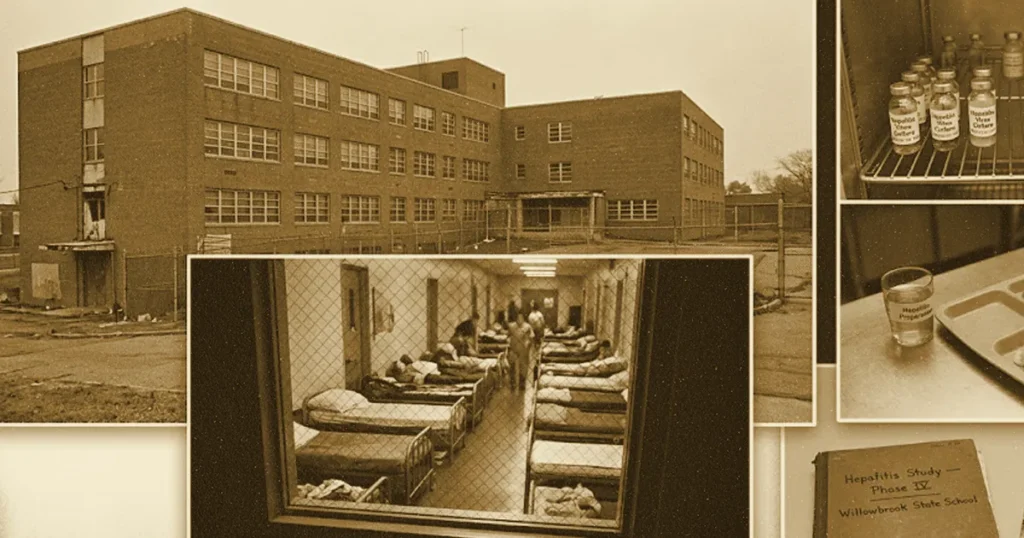
The Willowbrook State School for children with intellectual disabilities opened on Staten Island, New York, in 1947. Within a few years it was severely overcrowded, housing thousands of children and young adults in conditions that Senator Robert Kennedy, after an unannounced visit in 1965, described as a snake pit. Hepatitis was endemic in the facility, spreading through the unsanitary, chronically understaffed wards with the efficiency that pathogens achieve in overcrowded institutions. By some estimates, a child admitted to Willowbrook had roughly a one-in-two chance of contracting hepatitis within their first year.
In 1955, the New York University epidemiologist Saul Krugman was invited to Willowbrook to study and help control its infectious disease problems. What he did there over the next sixteen years was not control the disease. He deliberately infected children with it.
The Study and Its Justification
Krugman’s research at Willowbrook, conducted with colleagues including Robert McCollum, began with a genuine scientific question: could gamma globulin administration provide protection against hepatitis infection? The study design he chose to answer that question involved giving newly admitted children a preparation containing live hepatitis virus, observing the course of infection, and then studying immune responses and the protective effect of gamma globulin. In some protocols, children were fed stool extracts from infected individuals mixed into chocolate milkshakes. In others, they received the virus by injection.
Krugman’s defense of this methodology rested on several arguments, some of which had partial merit and some of which were circular in ways that critics identified immediately. He argued that children admitted to Willowbrook would contract hepatitis anyway, given the endemic nature of the disease in the facility, so deliberate controlled infection in a well-staffed research unit where they would receive close monitoring was actually preferable to natural infection in the general wards. He argued that parents gave informed consent. He argued that the research produced genuine scientific value.
The critics’ responses were pointed. The reason hepatitis was endemic at Willowbrook was the overcrowding and inadequate sanitation that Willowbrook’s administrators had failed to address. The “inevitable” infection was a product of institutional neglect, not a natural fact about children with intellectual disabilities. Deliberately infecting children with a disease because the institution housing them was too poorly run to prevent natural infection was a circular justification that required the initial failure to persist in order to remain valid. Cleaning up the facility would have eliminated the condition that Krugman was using to justify his experiments.
The consent argument was more complex. Parents were given tours of the research unit, explanations of the study, and the opportunity to ask questions. Some genuine effort was made to obtain agreement. But the Willowbrook research unit had its own separate ward, better staffed and better supplied than the general facility. In a severely overcrowded institution where admission was difficult to obtain, enrollment in the hepatitis study was at times the only way for a family to secure a place for their child. Whether consent obtained under those conditions was meaningfully voluntary was the central ethical question the case posed, and it was a question that divided ethicists for decades.
The Scientific Results
Krugman’s research at Willowbrook did produce genuine scientific contributions. His work distinguished between two strains of hepatitis with different transmission characteristics, which he called MS-1 and MS-2, the viruses now known as hepatitis A and hepatitis B respectively. This distinction was scientifically significant and contributed to the eventual development of the hepatitis B vaccine. The research was not without value. That is one of the reasons it has been studied so extensively in bioethics: it is not a case where harmful research produced nothing, but a case where harmful research produced something real, and the question of how to weigh those against each other does not have a clean answer.
When the study ended in 1971, Krugman was elected president of the American Pediatric Society. When he received an award from the American College of Physicians the following year, demonstrators tried to storm the stage. His career proceeded without formal professional consequences of any kind.
The Exposure and the Legacy
Willowbrook’s broader conditions became public through a 1972 broadcast by journalist Geraldo Rivera, then a young reporter for a local New York television station, who smuggled a camera into the facility and broadcast what he found. The footage of overcrowded, neglected children in terrible conditions outraged the public and eventually led to the closure and replacement of the institution through a landmark consent decree. John Lennon held a benefit concert for Willowbrook residents.
The hepatitis study is now part of what medical historian Susan Reverby calls the bioethics “holy trinity” of research horror stories, alongside Tuskegee and the Chester Southam cancer cell injections. All three were studied extensively in the development of the Belmont Report, the foundational American document of research ethics principles published in 1979, which established the requirements for respect for persons, beneficence, and justice in human subjects research. The particular element of the Willowbrook case that shaped the Belmont Report’s treatment of vulnerable populations was the consent-under-coercion problem: the finding that consent obtained in conditions where refusal carries serious consequences is structurally compromised regardless of how carefully the consent process is administered.
TL;DR: Key Facts and Why This Case Matters
Who was Saul Krugman?
Saul Krugman (1911–1995) was a pediatric infectious disease specialist at New York University who conducted hepatitis research at the Willowbrook State School on Staten Island from approximately 1956 to 1971. His research involved deliberately infecting children with intellectual disabilities with hepatitis virus using stool extracts and injections, in study designs that drew widespread ethical criticism. He was elected president of the American Pediatric Society in 1971, the year his research program ended.
What was the ethical problem with the consent process?
Willowbrook was severely overcrowded and admission was difficult. At various points, enrollment in the hepatitis research unit was the primary or only means by which families could secure a place for their child in the facility. Parents who participated in the study received informational sessions and tours of the research unit, which was better staffed than the general wards. Critics argued that consent obtained in conditions where refusal meant no admission was not meaningfully voluntary, regardless of how carefully the consent process was managed.
What scientific results did the research produce?
Krugman’s research distinguished between two strains of hepatitis with different transmission routes, now known as hepatitis A and hepatitis B. This distinction contributed to the eventual development of the hepatitis B vaccine. The research produced genuine scientific value, which is one of the reasons it has been studied so extensively in bioethics as a case where harmful methodology produced meaningful results.
Why does this case matter?
Willowbrook is a foundational case in the development of modern research ethics regulations because it poses the question of vulnerable consent with unusual precision: can consent be valid when the alternative to participation is exclusion from an institution that the participant’s family depends on? The Belmont Report’s treatment of justice in research, and its specific attention to the exploitation of captive or institutionalised populations, was shaped in part by this case. It also illustrates that genuine scientific contribution and ethically compromised methodology are not mutually exclusive, and that the value of the results does not resolve the questions raised by how they were obtained.
